How much productivity content have you consumed in the last 30 days? Articles, episodes, videos about a better system. Now the harder question: what did you actually change?
If the first number is huge and the second is basically nothing, you’re in the Productivity Content Trap.
Here’s the thing. Consuming productivity advice triggers the same dopamine reward signal as doing the work. You finish a piece of content and you feel sharper. You feel like you made progress. You got the reward without finishing anything. The trap is easy to spot once you look for it: the volume of content you consume vastly exceeds the number of behavioral changes you implement.
A week can feel highly productive because you were busy and you were “learning.” Your calendar was full. Your inbox felt heavy. None of that is the metric. Busyness and productivity are distinct. The only valid measure of productivity is what you finished or meaningfully moved forward, not how full the week felt.
Does this sound familiar? You closed the laptop on Friday with a vague sense that you worked hard, and you still can’t name what shipped.
Run this audit this weekend
You don’t need a new system to find out if you’re in the trap. You need three questions.
1. What productivity content have I consumed in the last 30 days?
Write it down. Podcasts, newsletters, videos, books, threads. Be honest about the volume. Most people underestimate this until they put it on paper.
2. What did I actually change in my behavior as a result?
Not “I thought about changing.” Not “I saved it for later.” What did you start doing, stop doing, or do differently? If you can’t name a specific behavior, it doesn’t count.
3. Did my output go up?
Finished work. Projects moved forward. Real output, not a fuller capture inbox.
A large gap between question 1 and question 2 is the trap. You already know the answer before you finish writing. Do the audit anyway. This weekend. Track output, not input.
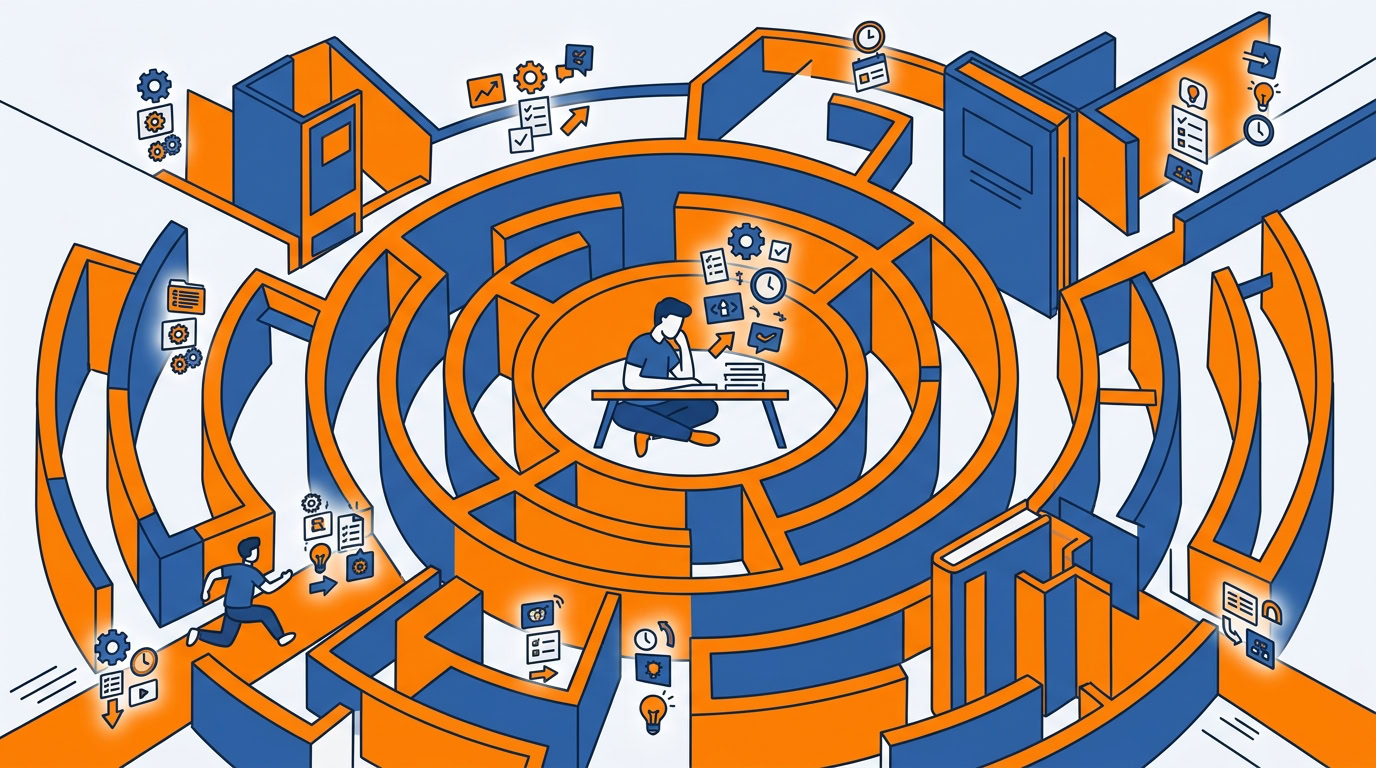
Three costumes the trap likes to wear
The content trap rarely shows up as “I watched videos all day.” It shows up dressed as improvement.
Frequent tool switching. If you have changed your primary productivity tool more than once in the last six months, look at your output before you look at the software. Frequent switching is often avoidance disguised as improvement. The fresh start feeling of a new app is a temporary dopamine hit. It masks stagnant results. Stick with your current tool for 30 days. Give the work a chance to show up before you go hunting for another app.
Planning the plan. Planning can be momentum. Helpful planning reduces uncertainty and orients you toward action. It can also be avoidance wearing a productivity costume. Elaborate templates. Quarterly reviews that leave you more overwhelmed and more distracted. More lists, less movement. Check your last planning session. Did it lead to action, or did it lead to another round of lists?
Note hoarding. Building a “second brain” (capturing, tagging, linking) feels like work. It can be a sophisticated form of procrastination. Capturing is not the same as using. The diagnostic is simple: the ratio of note growth to project completion. If your notes grow faster than your finished work, the system is a trap. Audit that ratio. If the notes are winning, the projects are losing.
Are you living in the costume, or in the output?
The One Small Experiment rule
I have a personal rule for this. When I consume productivity content, I don’t build a new workflow. I don’t add it to a system. I pick one specific idea and I execute it within the next hour.
That one-hour constraint is the whole point. It closes the gap between discovery and implementation. You test whether the idea is useful before you commit to a system change. Most ideas don’t survive contact with the next hour, and that’s useful information. The ones that do are the ones worth keeping.
You do not need a new stack. You need a tighter loop from “I heard this” to “I did this.”
The fix is to change the engagement model. Keep consuming high-quality content (The Productivity Show is built for this). Treat every piece of content as a prompt for immediate, low-friction action, not as a source of new system components. Learn. Then do something small with it before you file it, tag it, or turn it into a template.
Do this in the next hour
You already have more advice than you can use. Don’t add this article to the pile.
Pick one idea from what you just read. One. Run it in the next hour. Audit the gap, stay on your current tool, throw out a planning template that never led to action, or stop capturing and finish something that’s already in the notes. Then notice whether output moved.
That’s the test. Not how the hour felt. What got finished.
Recommended for you
Want the full system? 25X is the flagship productivity system we teach.
Explore 25X →