Last updated: 2026-09-07
Someone got a PDF of every item they owned.
A move forced them to store everything they owned for months. Packers boxed up the whole place. Items they didn’t need. Items they’d never used. Then the inventory showed up: a PDF of a life, line by line.
That is a humbling wake-up call.
The useful part wasn’t a fantasy of one heroic decluttering weekend. The easiest way to declutter is to stop buying things in the first place.
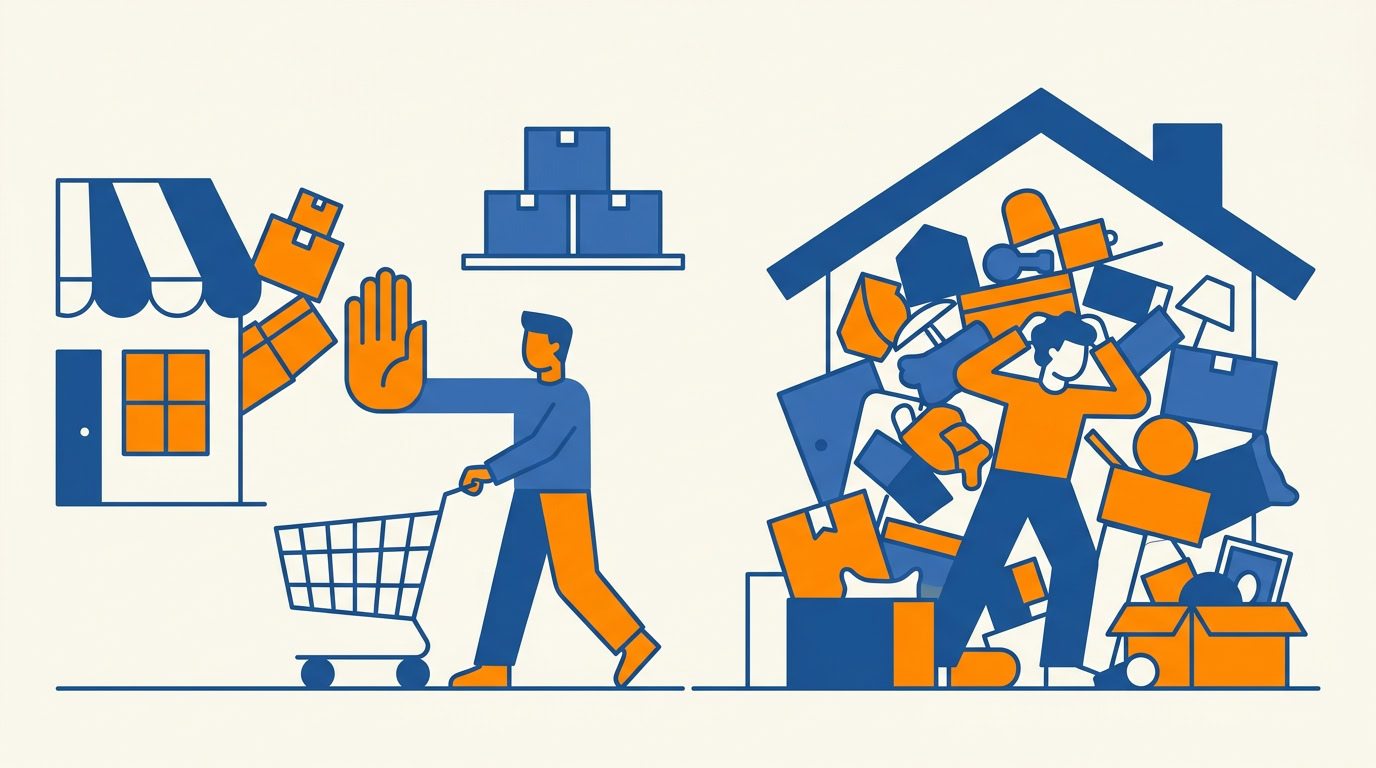
They came out of it with a policy of mindful purchasing. Every new subscription or gadget requires canceling or replacing an existing one. Replace, don’t add.
Want a new subscription? Name the one you’re canceling. Want a new gadget? The old one leaves. If you can’t name the replacement, you’re adding volume. That’s how you end up with a PDF you wouldn’t want to read.
Go audit your subscriptions this week. Then look at your want list. For every add, write the thing it replaces. No replacement, no purchase.
Online shopping makes this harder than it should be. One click, dopamine, box on the porch. Put a 24-hour wait on any non-essential item. Sleep on it. If you still want it the next day, it’s likely a genuine need or a high-value want. If you don’t, you just avoided another object with no job.
Drop those candidates in a Wishlist folder in email, or in one app you already use. Revisit them after 24 hours. The wait is the whole tactic. You’re giving yourself a sober second look before the purchase happens.
When you do buy, own fewer items and invest in higher quality. Five cheap water bottles is a clutter strategy. One high-quality bottle that lasts for years is a quieter one. Same pattern with backpacks. Cheap tech and fast fashion keep you in replacement mode. You buy again, you duplicate, you stare at extras you don’t use. Buy one thing that lasts and you cut the replacement cycle, the visual clutter of copies, and a lot of low-grade decision fatigue. You also get more utility and more satisfaction from what you actually keep.
If you want a list of things built to last, look at r/buyitforlife.
Alright. What about the stuff already on the desk?
Clutter is postponed decision-making.
You encounter a document, a piece of mail, a gadget. You don’t decide its destination or its fate. You think, “I’ll deal with this later,” and you set it down. Those delayed decisions accumulate. The pile is a pile of skipped judgments.
Bias toward deciding now. File this. Trash this. Put it where it belongs. The action can be tiny. The decision has to happen while the item is in your hand.
Does this sound familiar? A stack that “I’ll get to,” sitting in the same spot for weeks?
Pick up one pending item right now and decide. File it or trash it. Don’t put it back in the maybe pile.
David Allen’s 2-minute rule is for tasks. For physical objects, use a 30-second rule. If you can decide where an item belongs in under 30 seconds, put it away immediately. If you can’t make that decision quickly, the item has no defined home. That’s the root cause of future clutter. Homeless things have nowhere honest to go, so they land on the nearest surface and stay there.
Walk into your office and find one homeless item. Give it a home, or decide it doesn’t stay.
Every activity has an on-ramp: setup, scheduling, preparation. It also needs an off-ramp: cleanup, follow-up, archiving. Most people stop when the main activity ends. The off-ramp is where the maintenance happens.
A meeting isn’t over when everyone hangs up. It’s over when the notes are saved and the follow-ups are scheduled. Skip that and the next on-ramp gets sticky. You sit down again and spend the first ten minutes reconstructing what you already knew. Build the off-ramp into the routine and the next start is easy, in a digital workflow or a physical space.
What’s the off-ramp for your most common recurring task? Name the last two actions that actually close it. Then do those before you walk away.
Treat your workspace like a toothbrush. You don’t leave a toothbrush on the sink after you use it. You put it back in the holder so it’s ready the next morning. Clear to Neutral is that same reset for your desk. At the end of every workday, return the workspace to a neutral state.
Five minutes. Close the browser tabs (all 32 of them). Sort the papers. Put objects back. Do it so you can start immediately tomorrow, without a scavenger hunt.
Use this as an End of Day Reset checklist: every physical object back in its home, extra tabs closed, papers sorted, desk left in a state where work can start on contact.
One more layer, because a clean desk skill won’t hold if your head is full.
Clutter is often a symptom of mental overload. When your mind is stressed or cluttered with unprocessed tasks, you lose the cognitive bandwidth to make quick decisions about physical items. Stuff piles up. A weekly review is mental decluttering. It restores the capacity to organize the room you’re sitting in. This is the GTD habit most people skip, then they wonder why the desk keeps losing.
If you want a structure for that review, use the Weekly Review Blueprints mini-course.
Don’t overhaul the house tonight. Pick up one pending item and decide what happens to it. File it, trash it, or give it a home. One decision, while it’s still in your hand.
Recommended for you
Want the full system? 25X is the flagship productivity system we teach.
Explore 25X →