
Last updated: 2026-09-07
A friend once had to pack up everything they owned. When it was over, they saw just how much had accumulated.
Unused gadgets. Duplicates. Things bought, boxed, and forgotten.
Watching packers box up items they didn’t need, or had never used, was a humbling wake-up call. A lot of that stuff had never earned its place. And that’s when it clicked: the easiest way to declutter is to stop buying things in the first place.
You already know the other version of this story. You clean the desk. You feel great for a day. Then the pile comes back. Does that sound familiar?
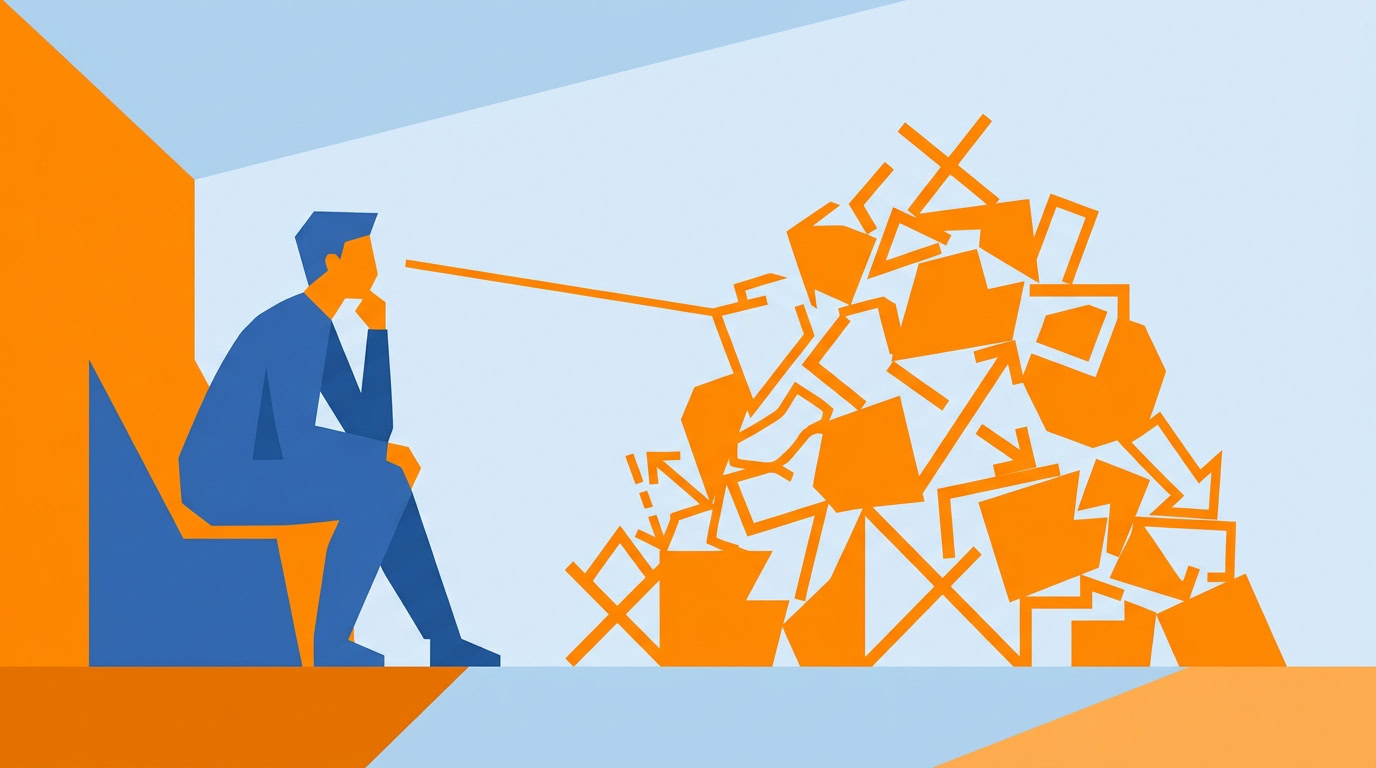
Here’s the thing. Cleaning treats the symptom. The pile is postponed decisions.
Make the decision now
Physical mess shows up when you encounter an item (a document, a piece of mail, a gadget) and skip the decision about its destination or fate. You think, “I’ll deal with this later,” and you set it down.
Later never comes. Those delayed decisions accumulate into clutter.
Bias toward deciding now. File this. Trash this. Put it where it belongs. Don’t defer the judgment.
If there’s a pending item on your desk as you read this, pick it up. Decide what happens to it. One item. That’s the whole practice.
The 30-second rule
David Allen’s 2-minute rule is for tasks. For physical objects, use 30 seconds.
If you can decide where an item belongs in under 30 seconds, put it away immediately. If you cannot make that decision quickly, the item lacks a defined home. That missing home is why the clutter keeps coming back.
Homeless items wander. They land on the nearest flat surface.
Look at your office. Find one homeless item. Where does it actually live? If you don’t have an answer, give it a home or get it out.
Build the off-ramp
Every activity has an on-ramp: setup, scheduling, preparation. You already do that part, even if you don’t call it that.
Most people stop when the main activity ends. That’s the gap.
A meeting isn’t over until the notes are saved and follow-ups are scheduled. The off-ramp is cleanup, follow-up, archiving. That’s where the maintenance happens. Build the off-ramp into the routine and the next on-ramp is frictionless.
Same idea for digital workflows and physical spaces. Saving the file. Putting the papers away. Scheduling the next action. Closing the laptop still leaves that work unfinished.
What’s your most common recurring task? Name the off-ramp for it. Write it as part of the task, not as a favor you might do later.
Clear to Neutral
Treat your workspace like a toothbrush. You return a toothbrush to its holder after you use it so it’s ready the next morning. Reset your desk to a neutral state at the end of every workday.
Five minutes. That’s the ritual.
You do this so you can start immediately tomorrow, without closing 32 browser tabs or sorting papers before the real work begins.
End of Day Reset
Clear the desk back to neutral. Close the tabs you don’t need. Put papers and objects in their homes. Capture leftover follow-ups, because that’s your off-ramp.
Five minutes today. A running start tomorrow.
When your head is full, the desk fills up
When your mind is stressed or cluttered with unprocessed tasks, you lose the cognitive bandwidth to make quick decisions about physical items. Stuff piles up because you don’t have the headspace to decide.
A weekly review is mental decluttering. It restores the capacity to organize your physical space. If you feel busy and still can’t keep a clear desk, process the open loops in your head first. The Weekly Review Blueprints mini-course is there if you want a structured way to run that review.
Replace, don’t add
After that, they put a policy in place: mindful purchasing. Every new subscription or gadget requires canceling or replacing an existing one.
Want a new app? Which one dies? Want another gadget? What does it replace?
Audit your subscriptions this week. Check your want list too. If you can’t name what the new thing replaces, you don’t need it yet.
Impulse buying fights this, especially with one-click shopping. Institute a mandatory 24-hour waiting period before purchasing any non-essential item. If you still want it the next day, it’s likely a genuine need or a high-value want. That friction removes the dopamine hit of the immediate purchase and gives you a sober second opinion.
Drop those items in a Wishlist folder in email, or any list you already use, and revisit them after 24 hours. Most of them won’t survive the night.
When you do buy, own fewer items and invest in higher quality. Instead of buying five cheap, short-lived water bottles or backpacks, buy one high-quality item that lasts for years. You replace less often. You don’t collect duplicates. You get more use, and more satisfaction, out of what you keep. Cheap tech and fast-fashion thinking work the other way: more items, shorter life, more decisions, more visual clutter.
If you want a place to research that kind of purchase, start with(https://www.reddit.com/r/buyitforlife/).
Pick up one pending item on your desk and make a decision. File it, trash it, or give it a home. Do that before you close this tab.
Recommended for you
Want the full system? 25X is the flagship productivity system we teach.
Explore 25X →