Last updated: 2026-09-14
This started as a spiritual conversation about life paths. Then I applied it to work.
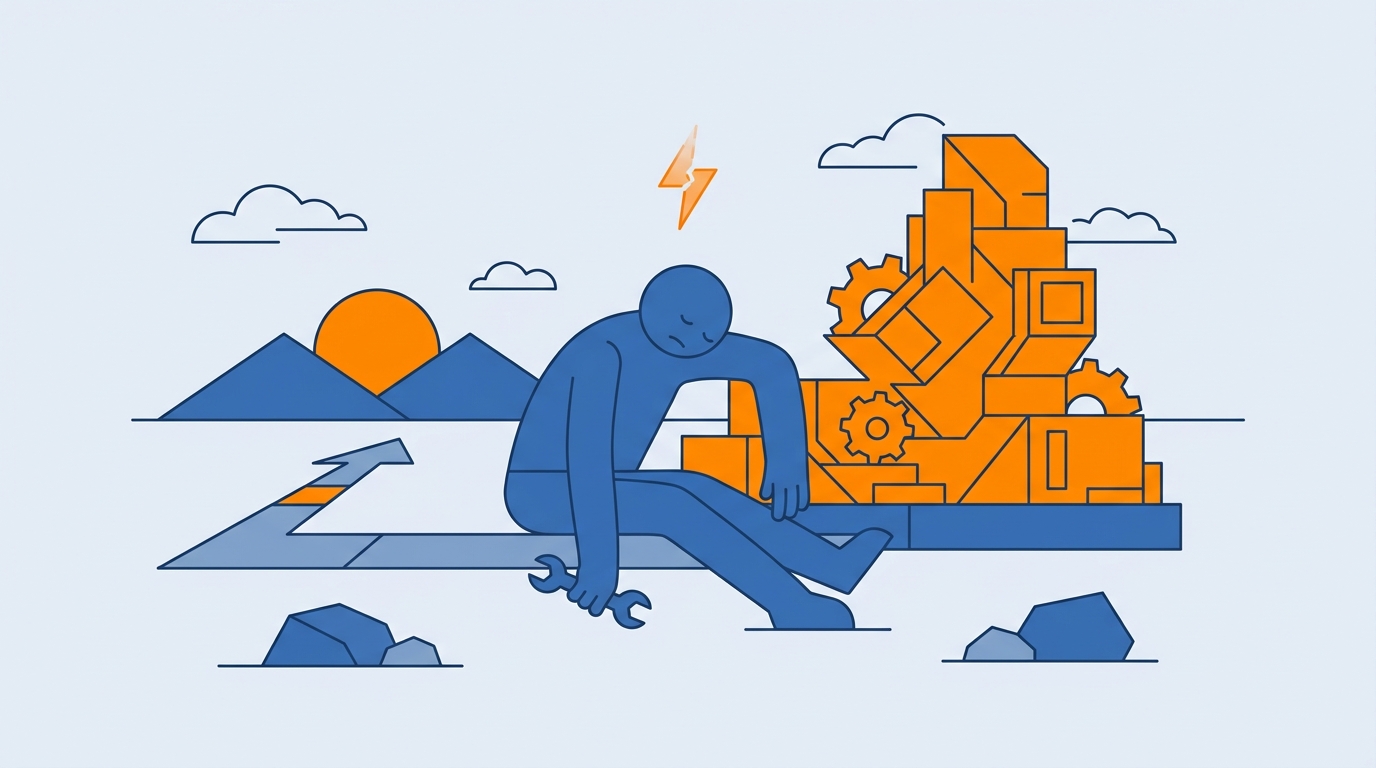
You can choose easy now and hard later. Or hard now and easy later.
Does this sound familiar? You take the path of least resistance today. A workaround. A shortcut. A new AI tool. The task you skip because it isn’t due yet. Then the same problem shows up next week.
Hard now is the higher initial investment with compounding returns. You commit to one tool. You fix the recurring problem for real. You spend 30 minutes on work that isn’t due for 30 days.
I had to learn this the long way.
Stop collecting AI tools
People are switching between ChatGPT, Gemini, and Grok constantly.
Here’s the thing. The productivity cost of constantly switching between new AI tools outweighs the marginal benefits. You feel like you’re keeping up. You’re mostly restarting.
Deep proficiency in one tool builds a transferable skill: prompting. Prompting comes with you. Surface-level familiarity with many tools does not. The tool will change. The prompting skill stays.
The anxiety of rapid AI evolution is real. You don’t want to pick one and be wrong. Commit anyway. Three months inside one tool will beat three months of sampling.
Which AI tool are you committing to for the next 3 months?
The Three Times Rule
Brooks has a clean test for when a shortcut has overstayed.
If a short-term hack or workaround is needed three times, implement a permanent, long-term fix. Using the same band-aid repeatedly indicates a systemic issue that requires structural change.
What is the one thing you’ve had to fix three times this week?
He applies the same threshold to tools. A laptop, a webcam, the software you live in. If a long-standing tool has become a productivity drag and it causes friction more than three times, it’s time to upgrade. Even if it was a good investment initially. The cost of the upgrade is often less than the cumulative cost of the friction.
Brooks hit that line and upgraded from an Intel MacBook to an M3 MacBook.
What’s your current productivity drag?
I documented too early
“Systematize everything” is popular advice. I followed it at the wrong time.
When I was founding my company, I tried to build perfect systems and documentation too early. It pulled me away from the only thing that matters in the early stages: generating revenue.
Before the model is proven, the system keeps changing. After it’s proven, that same system becomes valuable and stable.
Are you documenting things that will change in 3 months?
If yes, stop documenting and go generate revenue.
One tweak a week
Doing the same thing over and over leads to stagnation. The other trap is the full system overhaul, which is how you get overwhelmed.
Brooks’s suggestion: one tweak a week. Commit to improving one small aspect of your workflow or output every week. That creates a culture of continuous improvement without the overwhelm.
What is your one tweak for this week?
Pair it with a tactic I use when urgent work keeps eating the future. I call it the 30/30 Rule. Dedicate 30 minutes today to working on a task that is not due for 30 days.
Low friction. Doesn’t disrupt current urgent work. Prevents future crises and builds long-term momentum. Urgent work will always fill the day if you let it. Thirty minutes is small enough that the urgent work still gets done.
Pick one 30-day deadline and spend 30 minutes on it today.
Time is the first layer
Brooks treats the T Framework as a progression model.
Time. Energy. Attention.
Time management is the reactive, short-term layer. Energy and Attention management are the proactive, long-term layers. True productivity mastery involves moving from managing time to optimizing energy and attention simultaneously.
Where are you stuck in the T Framework?
I used to exercise in the morning. I moved it to the afternoon.
One habit, all three pillars. I protected my peak creative hours (Time). I recovered energy for the rest of the day (Energy). I maintained focus on high-value work (Attention). I didn’t add a new habit. I moved an existing one. You don’t need a new routine to work all three T’s at once. You need a better slot for a habit you already have.
How can you rearrange one habit to maximize all three T’s?
Record everything
As an educator and speaker, I make promises in the heat of the moment. I’ll send that later. Then the workshop ends, the call ends, and I don’t send it.
So I record everything. I use a dedicated audio recorder, a credit-card-sized device called the Applaud Note, to capture entire workshops and calls. Then I use AI to transcribe the recording and extract action items.
If I say I’ll send something, it has to go out. Follow-through on those promises is a differentiator. The recorder plus AI is how I catch the promises I would otherwise drop.
What promises do you make in meetings that you forget?
Convert one habit
Identify one easy-now habit you want to convert into a hard-now system.
The AI tool you keep abandoning. The workaround you’ve used three times. The 30-day deadline you haven’t opened. The meeting promise you never wrote down.
Spend 30 minutes on that today. Just one.
Recommended for you
Want the full system? 25X is the flagship productivity system we teach.
Explore 25X →