I built 50 AI agents for fun, with no direction under them. I thought the building was the work. It was productivity porn. Clever tools, nothing they were aimed at.
I kept systemizing everything. A new system felt like progress, so I made another one. Systems theory has a term for the place where a small change creates the biggest impact. A leverage point. I had skipped it. Fifty agents. Very little leverage.
The fix was naming the direction before the build. I picked “make AE AI-native.” Then every new agent had to serve that sentence. Some of the old ones were still fun to think about. The direction decided which ones stayed.
So ask it plainly. What is the direction I am trying to go? If you can’t answer in one sentence, stop building tools for the sake of it.
The goal makes the middle feel like failure
A goal creates a binary state. You sit in pre-success failure until the outcome shows up. Doing the work doesn’t count in your head, because the only score is the finish.
A system gives you a destination and a daily win. The win lands the day you do the work.
A one-time target can be met and the crash can come right after. A better system is to save 10% of every paycheck. A goal is a destination. A system is the vehicle. Stay in the vehicle and the growth stays sustainable, with no crash after the goal is hit.
You can feel the same binary in a resolution. “I must lose 20 pounds” leaves you failing until the scale cooperates. “I walk 10 minutes daily” gives you the win on the day you do it. Shifting to the daily system replaces the anxiety of the final outcome with the dopamine of immediate feedback. The walk happened. The feedback was instant. The system is still waiting tomorrow.
Check the goal in front of you. Is it a one-time target, or a habit you can still be running later? Reframe one resolution into a daily system. Write the daily version down.
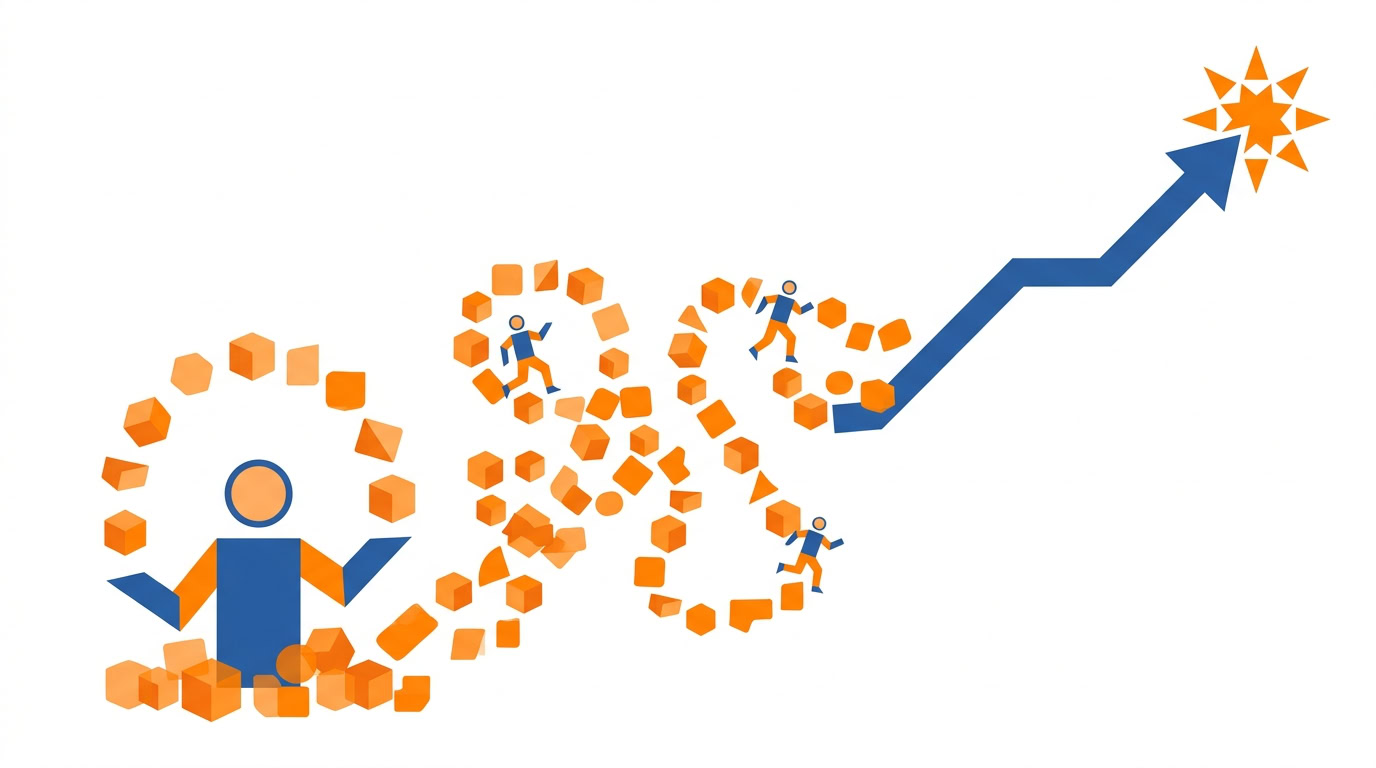
Do the boring process on purpose
Most people who succeed at speaking or at business, Brooks will tell you, do not wing it. They do not hit a home run right away. They follow a known three-step process, and they run it consistently. The outlier who gets there on luck is rare. The person who grinds through the boring parts is the normal case.
Read this next to the idea of letting other people be. The concept to steal is systematic consistency over shiny object syndrome. Consistency beats intensity. My 50 agents were intensity. Novelty, mostly.
I used to start with the interesting build. Now I start with the direction, then I pick the boring system that serves it, and I repeat that system.
What is the boring system for your current goal? Name it. Commit to it for 30 days. Include the dull days. Those are the days the system is actually doing its job.
A to-do list will not correct you
Systems go nowhere without a feedback loop. If nothing in the system can tell you what went wrong, you repeat the mistake and call it discipline.
Brooks draws the line the way Black Box Thinking draws it. Aviation runs on tight feedback loops, and safety stays high because of it. Healthcare often avoids the same kind of feedback, out of fear of liability and of being sued, and the work stagnates.
I’m no pilot, and I’m no doctor. The pattern is still obvious from where I sit. Review is what changes the next rep. Execution alone just reprints yesterday.
I pulled my own loop in tighter with a weekly review I do by voice. A custom GPT asks me 15 to 20 questions. I answer out loud. The AI summarizes the insights and passes them to an agent that monitors my daily schedule. That agent flags gaps.
A typical flag: “You planned to record 3 podcasts, but you have 0 slots today. Consider this empty window.” The feedback used to arrive in weeks. Now it arrives in days. I spend less effort trying to remember where I drifted, because the system remembers for me.
Audit one system you are running this week. Does it have a feedback loop, or is it a to-do list? Build a simple weekly review prompt, or hand the week to Notion AI and let it summarize your wins and your losses. Then actually read the summary. The summary is the black box. If you don’t open it, you don’t have one.
Start smaller than your pride wants
When I got into running, I didn’t start by running. I put my running clothes on every morning. To code, I opened the coding agent for 10 minutes. The friction is in the start. The activity is the easy part once you have started.
Call it the smallest viable step. Find the friction point of the new habit, and shrink the first move to a 1-minute action. Running clothes on, every morning. For code, the coding agent open for 10 minutes. Pick the version you cannot talk yourself out of.
Do this before you build another tool
Write one sentence: the direction you are trying to go. Then do the one-minute version of the boring system that serves it, today.
Recommended for you
Want the full system? 25X is the flagship productivity system we teach.
Explore 25X →