

Speed reading is not a complicated topic. While there have been books written and 3-day seminars held about the subject, they’re mostly full of fluff and practice sessions. What we’re going to cover here is the 80% that I think really matters. The other 20% is the fun “oh, let’s go from 1,000 wpm (words per minute) to 5,000 to 20,000 wpm” stuff – in other words, the unnecessary stuff. I think it’s fair to say that most people simply want to get their reading speed up to the point where they can whisk through information and reading material easily and without effort. There’s no real need to set speed reading and comprehension records. In The Dojo, our productivity community, we have training course just for speed reading.
There are a number of ways you can learn speed reading. I personally learnt it through a combination of classes, talking to people who read quickly and through reading a couple of books. You’re going to get the complete set of basics here – where you go from here is entirely up to you.
Here are the components to learning speed-reading:
- Foundational Beliefs and Best Practices. These are the very important and often unspoken ideas behind speed reading, and things you should keep in mind while you’re learning this skill and going about your everyday reading.
- Reading with a pen. This is speed-reading 101: using a visual aid to break old habits and instill new ones.
- Reading without a pen. Going from conscious competence to unconscious competence.
- Photoreading. This is the next step beyond speed reading. It’s a completely different way to look at information absorption.
Foundational Beliefs and Best Practices
Let’s start with the basics.
The first premise of speed reading is that the way most people read, is incorrect. Most people sound out words when they read – either out loud, or using an inner voice in their heads. This is an effect of how we were taught to read when younger – sounding out each word one-by-one, out loud. The problem with this is that it limits the speed at which you read to the speed of speech, which is relatively slow.
If you want to look at this in term of representational systems, the strategy that most people follow is:
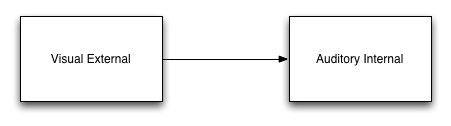
Or, if you read out loud:
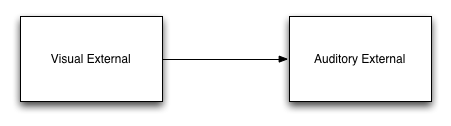
The proper strategy for reading fast is this:
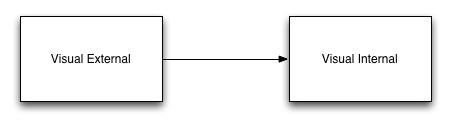
What this means is that as your eyes scan through words, sentences and paragraphs, your mind creates internal visual representations of those words and organizes them into images. This happens at multiple levels:
- Word level. This is where each word becomes an object or action in your internal images.
- Sentence level. This is where you scan each sentence, then form an image from it.
- Paragraph level. This is where you can scan each paragraph, and then form an image of set of images or a short movie from it.
- Page level. If you get really good at speed-reading, you’ll be able to translate multiple paragraphs or entire pages into images.
The way to train your brain to read with a visual external to visual internal strategy, is to use a visual aid, which we’ll discuss in the section Reading with a Pen below.
As equally important as how you read, are the foundational ideas behind why you read – your philosophical approach to reading if you will. Here’s some beliefs that I’ve found useful when it comes to handling reading and information:
- You don’t have to read everything.
- You don’t have to read in order.
- You don’t have to speed read all the time.
- You don’t have to have perfect comprehension.
Let’s look at these one-by-one.
Not Reading Everything
There seems to be this strange idea (especially amongst students and academics), that you have to read absolutely everything. This is just not true, and it’s something that I wish I paid more attention to during university. You don’t have to read everything.
The presupposition behind this is that when you read, you read with a purpose. Usually, this is the extraction of information from a piece of text. Once you have that information – you’re done. There’s no need to read any longer.
If you’ve spent time in college, you’ll know that the textbooks they issue are huge. In fact, I would say that most of those textbooks are simply filler – you don’t need to read all of it, just the relevant parts for your learning and education.
Outside of an academic context, I have a rule: if I start reading a book and after a chapter it still sucks, I’ll stop reading it and move on. No point wasting your time on something that won’t help you get to your purpose for reading.
Not Reading in Order
Another misnomer is the idea that you have to read cover-to-cover, start-to-finish. This is rubbish. There’s absolutely no reason you can’t start by reading the conclusion or summary, then go back to the introduction or jump around through different chapters. Sometimes it’s worth picking what you’re interested in from the table of contents or index and starting there.
Not Speed Reading all the Time
When I tell people that I speed-read they usually ask me to “prove that it works” or ask me about comprehension rates. This is just silly. It’s not necessary to read fast all the time – sometimes you want to slow down and enjoy a good novel. Even with non-fiction material, sometimes you want to take your time (speed reading takes concentration). The reality is this: as you read, sometimes you’ll be “speed reading” so to speak, scanning rapidly through paragraphs and pages. Other times (in the same session), you’ll slow down and read word-by-word.
Not Having Perfect Comprehension
The other common request of speed readers is “perfect” comprehension. I’m telling you now that there’s no such thing. Your comprehension will go down a bit when you speed read – before, you were sounding words and then using the sound of those words to build visual images (a slow process). Now you’re using visual representations of world to build visual images (a faster, if initially unfamiliar process). If anything, the quality of your comprehension changes rather than the actual “percentage”. I personally think that the idea of comprehension testing speed readers is silly, as when you read, you read for a purpose and for certain bits of information anyway – no one cares if you remember every single fact and statistic from a book, or what the 6th word in the 22nd sentence on page 371 was.
A corollary to this is that you don’t need to understand absolutely everything in a piece of text. We mostly read to understand main concepts anyway. If you really absolutely must understand everything, you should be taking notes (or drawing a mindmap), and you can always reread certain sections to note down facts and figures.
A couple of other ideas that will help with speed-reading:
- Book summaries are often as good as the book itself. Wikipedia can be quite useful for this.
- eBook readers like the Kindle or iPad are awesome for speed reading.
Reading with a Pen
Now that you have a strong foundational base from which to start speed reading, let’s look at the actual mechanics of it.
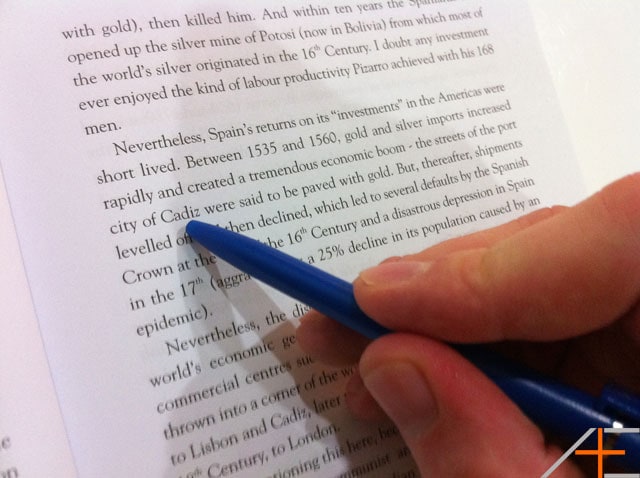
The first thing to do is to get a pen (or chopstick or straw or any other form of pen-shaped visual aid). As you start reading, place your pen at the beginning of the paragraph, and move the pen, left-to-right with a steady pace. When you reach the end of the sentence, go to the next, and follow left-to-right. Your eyes should follow the pen. And you should read in accordance with the movement of the pen.
This will feel a little weird at first, as you’ll keep trying to sound out the words. But stick with it, and eventually your brain will give in and you’ll start “reading” at the pace which your pen moves. The trick is to start with a slower left-to-right movement, and speed it up over time.
As you get comfortable with reading with a pen moving left-to-right, you can start trying different variations to help you read even faster:
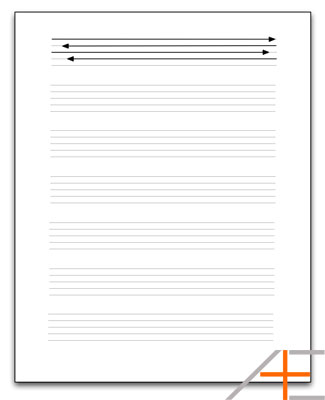
This is where you go left-to-right for one sentence, then go backwards right-to-left on the next.
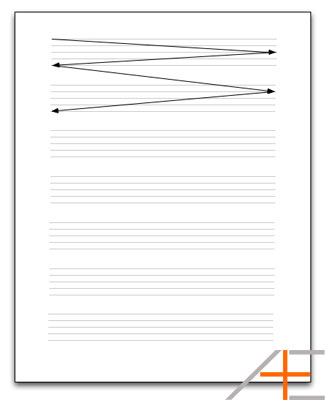
This is where you move the pen diagonally, crossing 2-3 sentences at a time, then zig-zagging back other way for the next 2-3 sentences.
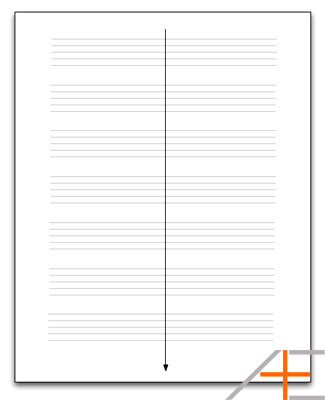
This is where your visual focus sits in the middle of each paragraph, and as you guide the pen down the page, your peripheral vision picks up the contents of each paragraph, and your mind translates it into meaning.
Reading without a Pen
The simple way of reading without a pen is to use your finger.
The more advanced way, is that eventually the visual patterns that you’re used to using with a pen will be replaced by your eyes simply focussing in those patterns – you’ll be able to zig zag, or read vertically down a page without having a physical visual aid.
Photoreading
Photoreading is the next level of speed reading. It’s an entire reading system in and of itself – if you’re interested in it, their website is https://www.photoreading.com/.
The idea behind the system is to put yourself in a self-induced altered state (using principles similar to meditation) where you can absorb information simply by looking at page, then turn to the next page, then next page, then next page. I’ve personally never taken one of their courses, but I’ve met people who have and it’s the real deal.
What I do is a bit different. I could never get the “photoreading” state to work for me the way it seems to work for others, but I still do it. Here’s what I took away from reading their book and talking to trained photoreaders:
- When you start reading a new book, start with scanning and skimming everything. Look through a book’s chapters, table of contents, index, blurbs, and feel free to dive into various chapters and reads bits and pieces as you feel like.
- Do the photoread. This means sit down, quiet your mind, concentrate, and change your visual focus so you’re picking up things on the periphery. Extend this periphery to the edges of the book. Now flick through page-by-page and go through the whole book. For some people, this is enough. They’ll be able to either actively or spontaneously recall information from the book. Personally, I find this tough.
- Create a mindmap based on initial scanning and skimming, and the photoread.
- At this point you have a number of options. You can choose to speed read the book normally, filling in the mindmap as you go. You can read the chapters you want. Or you can read it randomly piece-by-piece. There’s no approach that’s suitable for every book or text – it simply depends on your purpose for reading and the nature of the book.
Whether or not you believe in the idea of photoreading, the system itself is extremely effective for reading books. It simply works differently for different people.
Next Actions
- Really consider the idea that you don’t have to read everything.
- Start practicing speed reading with a pen. As you get better, drop the pen. Once you’ve got that down, take a look at photoreading.
Have any questions about speed reading? Ask away in the comments!
Photo By: Liz Grace

In the paragraph with the heading, Not Reading In Order, the word ‘misnomer’ should be ‘misconception’.
Thanks a lot to the author, very helpful
I work as a high school teacher and reading through long blocks of texts can be daunting at times. I ended up taking a speed reading class that I heard about on goodreads and speedreadinfo.com and now managing my time is better than I thought. I’m now able to go through essays and grade test questions way faster than I had been.
My and my husband got the Spreeder program a few weeks ago after much back and forth. I must say I liked the pace of the course, and I actually enjoyed it more than I thought. I haven’t checked out the app yet but will definitely download it once I upgrade my old phone. Looking forward to reading more books and keeping up with my goodreads goal for 20 by year’s end!!!! thx!
Thanks for the article. I borrowed the photreading course from a friend once and tried it out. I was able to get into the mind state they talked about and read through the books quickly, but my retention wasn’t good at all. When you listen to the creator of the concept, along with others who go through the course, you’re supposed to be able to get into the mind state, photoread a medical dictionary (for example), then suddenly these words you didn’t know before will somehow appear to your mind. It’s bizarre and it never worked for me.
I’m already a fast reader now with fairly high comprehension, but will be going into a Master’s program at a local University soon and improvement is always helpful! Thanks again!
Thanks very much for the article. For those of us who lack the motivation and / or self discipline required to create our own practice programs, could you suggest some software based course that implements the techniques you have indicated? Thanks very much in advance!
This is an excellent article. It’s a good summary of some of the ideas in the book “Breakthrough Rapid Reading” which I read months ago and still use to practice. This article condenses some of the core concepts and is a good introduction to reading faster. The book definitely helped my resting reading rate and also my speed reading rate, which aren’t the same. There is a difference between the two and there should be. I’ve increased both my wpm and my comprehension and I would highly recommend the book to anyone reading this who liked the article and wants to be a faster and more effective reader.
I was reading your post just to criticize you, but you proved me wrong.
Why I wanted to criticize you was because I’ve read a lot of silly things on speed/photo-reading, especially people who write discouraging posts or lie about how fast you can read within 4 nanoseconds without telling us the ORIGINAL SECRET behind it.
I love, love, love, LOVE your post.
I’m a slow reader or I should say, ‘I was’ a slow reader.
When I was in school in Singapore it took me time to finish my school works and I hated it. But now I’m willing to do anything (even if it’ll require me to swallow a grenade) to be if not the fastest reader, then at least a man who can read 10-20 books a day with great comprehension.
I’ve set-out 2 years to get it handled, then subsequent years for practice and enjoyment.
I don’t want to write a long post, because most people don’t read it, but I have something I want to tell those who are interested in speed/photo-reading.
If you’re not interested in improving your reading speed PLEASE don’t read the remaining post. It might just be a waste of your precious time. Thank you for your understanding. We need more people like you!
Let’s go.
If there is nothing pinching you to get this handled you’ll probably give up. I don’t want you to give up because if something as BIG as a (man-made) airplane can fly, then something as MIGHTY as your (God given) brain can handle anything. Speed Reading or Photo Reading shouldn’t be a mystery or too amazing for the brain to handle, the brain can do better than that.
Before you get started you NEED to have a mentor who has done what you’re about to do. For me? I have 4 mentors.
1. Howard Berg – World’s Fastest Reader. (Love his articles and techniques)
2. Paul Scheele – PhotoReading Whole Mind System. (Love his belief)
3. Evelyn Wood – Seven Day Speed Reading etc.(Love her techniques)
4. Peter Kump – Breakthrough Rapid Reading (Love his book) and sometime Tony Buzan (Love his writing style and Mind Map books)
I started Photo Reading in 2010, but gave up because I couldn’t put my head in the right state of mind. I gave up for now, but I haven’t given up. I’ll do it again when I’m proficient with Speed Reading.
These are my plans and things I’m doing/have done to get this easy but overrated skill mastered.
I always tell myself everything is easy if I just try a little more. I NEVER GIVE UP.
1) In books we have things like punctuation, symbols, dates, numbers, tables, images, etc.
I’m developing a system that’ll take care of the above list. Everything has been assigned an image. Example: Comma(,) = Common (American rapper), Me = Meat, Go = Goat, He = Heater and so on. So, every book I read becomes a funny and addictive movie. (I laugh while reading).
2) Numbers are crucial, so I have a Mnemonic Number System for 1, 2, 3 and 4 digit number combination.
Example: Page 9657 = Bill Clinton, page 3576 = Michael Jackson, page 1 = T.I, page 763 = Kim, and so on. Every number combination has an image instead of the number itself. When I see a number, I see an image. Google ‘Major System’
3) I downloaded 5000 Most Common Words in English from https://www.wordfrequency.info/free.asp and every word has been arranged by part of speech and by length. And I’ve download images for almost all the words, some are objects like of = oven, joke = Joke (a musician), and so on.
4) When I start Speed Reading I never blink my eyes until I finish the book, thanks to EyeQ software and my determination. I’ve done a 2 hours exercise without blinking. Tears dropped, but it was worth it.
5) I practice for 3-4 hours every day (and yes, I have time on my hand for now). I can’t remember the last time I slept in the night. I’m always awake till dawn. I’ve trained myself never to sleep at night. I feel like everybody is busy being success while I’m asleep. So, I don’t sleep, but when I do I make sure it’s up 7-9 hours.
6) When I read, I use stop watch and metronome. I love reading with rhythm and I use the dictionary as my practice book. The words are very small, so when I start reading a normal book it gets easier because of the font size difference.
7) Comprehension is not my problem for now. I don’t care about comprehension yet. I just want to get the techniques down. At the end of my exercises I tend to understand a lot of the things on the book because I NEVER wander on a page. If I do, I’ll start all over as a punishment for not paying attention, so I concentrate deeply to the process.
8) I’ve developed a lot of exercises like:
a) ‘The dictionary’ – I go through the entire Oxford dictionary everyday just looking for a particular thing like symbols only, Capitalized words only, Names/Countries only, Other concrete nouns only, Numbers and dates only, Words ending with ies, es or s only, and so on. It takes me an hour for each and I never stop rest or change hand until I hear my alarm.
My left hand has been trained to rub the dictionary for more than an hour without stopping or switching. I don’t feel pains anymore and I don’t blink my eyes. Tear will drop, and when it stops I tend to see the entire page in a second – I get into a state of awareness.
b) ‘DashDashDashDash’ This exercise is the best I’ve ever used to get me focus and pay attention to every single space between words at a high speed. This is how it works. I Imagine all the spaces on a page are dashes(-) instead of spaces. This thing tricks the brain to think all the words are one. I never see words the way they are, so ‘house’ becomes -house-, ‘when’ as -when-, and so on.
Every word is connected to every other word. (The link speed reading system). Now, all I do is read only the dashes in-between the words forward and backward without stopping until the book finishes. It takes me 5-15 minutes to finish 250-600+ page book. Remember I don’t care about comprehension, but I end up understanding a lot because I was reading without pressure of comprehending anything.
Example of the ‘DashDashDashDash’ technique. “The-first-premise-of-speed-reading-is-that-the-way-most-peopleread,-is incorrect. Most-people-sound-out-words-when-they-read-either-out-loud,-or-using-an-inner-voice-in-their heads. This-is-an-effect-of-how-we-were-taught-to-read-when-younger–sounding-out-each word-one-by-one,-out-loud.
You go from right to left, then from left to right (with a pointer) while continuously chanting to yourself ‘DashDashDashDash’. Pay 100% attention/concentration to nothing but the dashes. If you go past a line, then realized you went past a line without paying attention, you should start all over again. Don’t blink, chant and concentrate 100% till the end of the book.
Exercise: Open a book on MS word, then change all the spaces to dashes. Print the book or practice with you device. NEVER STOP and NEVER READ. Keep pointing and chanting.
Advance/Adult method: The spaces are called ‘dash’ while the main words are called ‘idiot’. So, you can chant ‘DashIdiot’ repeatedly. This method combines speed reading and humor/insult.
c) …more? I have more to say, but I’ll stop here.
Thanks for sharing :)
Hi Aaron
I loved your article and I’ll definitely try it out.. I’m a very slow reader. So slow that I get bored!
I read a lot on my laptop (sometimes on the iPad). How do you suggest to Read with a Pen on a laptop? Use a real pen? Finger? Regular mouse cursor or a really big mouse cursor?
On the iPad I have a similar problem, my finger keeps selecting text or changing page while I read. What works for you on the iPad?
Thanks,
Filipe
I’ve learnt to just scan vertically down my iPad screen with my eyes. You could also use a soft pacer or something that won’t scratch your screen if you want – I believe the touch display is conductive and it needs to be foam or your finger to interact with the screen.
When I was at 4th grade, our teacher taught us how to speed read. We had some books with vertical lines drew on the pages, and the rule was “you can only look at the lines”. At first we had 3 lines, then 2, 1 and finally none, but the teacher still tracked the time to see if we were fast-reading.
Until I reached college I was convinced that every person knew this simple trick. Thank you teacher!
I wish I had this teacher when I was younger!
There is nothing like reading a good thriller, like you’re watching a movie and at the end you go “What?!?! That took only 15 minutes? It took me a while to get used to it.
If you have a photographic memory (I believe we all do) it beats those comprehension tests. This brings me to where I disagree with the article, that comprehension takes a hit when speed reading. If your intention is to comprehend all the written material, you can speed read and comprehend as much as you would have taking your time.
What you probably meant was that by selecting only certain important stuff you will not comprehend everything. But that applies to slow reading too.
Yeah comprehension is one of those weird things. I think in student and academic circles it refers to being able recall every minute fact in a book which I personally think is just silly.
And as I mentioned, for most purposes of reading it really doesn’t all that much anyway.
p.s. Thrillers are awesome. Check out Matthew Reilly’s books – they read like big screen action movies.
Great article. How about when reading abstract material? For my case, I tend to read a lot about software concepts. When reading a story, it’s easy to project the scene as it’s being read, but I find it hard to apply on the said materials. Any tips?
salam. may God bless you . what you have told is good for me and it cleared a lot of confusion in my minds,, but one thing that i want to ask is that when i personally start to read an article i could not understand over that article even after trying my best i failed , i could not genrate a map in mind of what i read, .. when i reach to the next page or paragraphe i usully forgot what i have learnt in previous paragraphe or page. if you have good suggesion for me then do let me know.. thanks..
Just takes practice. To be fair, some texts are hard on comprehension – for example, I’ve tried reading A Brief History of Time multiple times and it just goes right past me. May be a case you need to bridge the subject matter a bit first.
This article is very informative and takes it a lot further than most articles about speed reading. My problem right now is that I still do the sub-vocalizing to much, but with the exercises in this article I might be able to eliminate some of this.
Thanks for the Info.
Ed
Thanks for the speed reading article. On a similar track, I’ve been playing audiobooks on my iPod touch at 2x speed to do my “speed reading.”
But, yeah, there are times when a good simple page works better. I’m psyched to try out the speed reading technique.
I like these tips. Thank you author.
What’s up Aaron,
How you been man, haven’t seen you since SC back in 09 haha. Hope all is well!
This is a cool article bro, been interested in learning about how to do this for a little while now, never actually set aside time to learn tho. Thanks for the foundations, going to start doing the Pen Technique.
Are you going to continue to drop knowledge on speed reading?
Talk soon homie,
Adam
What up dude!
There isn’t really much else beyond what I’ve written – the rest is just getting faster and getting your comprehension up if you really want.
I know it sounds like a supercool idea when you hear about it, like damn… I could read 5 books a day and I’ll be a genius in a week. Fun when you’re really motivated to learn about a subject, but I don’t know anyone who does that week-in-week-out. Just read what you want, and when it’s useful =)