Every year after a major conference in Austin, I notice the same crash.
I host people. I attend events. I socialize heavily. I have a great time. Then I end up completely exhausted.
The hosting is enjoyable. The events are enjoyable. The socializing is enjoyable. And I still finish that stretch completely wiped. Recurring drains need boundaries and a recovery plan. I have to put those in place before the next one, not after I am already empty.
Does this sound familiar to you?
Most people in that spot reach for time. New focus blocks. A tighter calendar. Another app. Time is the part of productivity you can see, so it feels like the part you should fix.
Your productivity system is a supercar. The calendar, the workflows, the apps, the focus blocks: that’s the car. Energy is the gas in the tank. You can have the perfect setup and still go nowhere if the tank is empty.
Time-blocking alone is not enough. Time management fails when it ignores energy. A perfectly blocked calendar does not help if your body and mind do not have the capacity to do the work. Energy is the fuel that makes productivity systems actually move.
At Asian Efficiency, this lives inside TEA: Time, Energy, Attention. Once you get decent at managing time, energy is the next hurdle. Treat every hour as equal and you will keep dropping important work into windows where you have nothing left to give.
Your battery is doing more work than your calendar
I think about stress tolerance like a battery.
When your battery is low, small frustrations feel bigger. Focus drops. Burnout risk rises. When your wellness baseline is higher, you can handle intense work periods without paying as high a health cost.
Skipping sleep to get more done is like draining that battery to 10% and then wondering why you cannot focus. You create more hours on paper. You also reduce the capacity you need to use those hours well.
Sleep and movement are productivity basics, not optional extras you get to after the real work. They are the foundation the battery sits on. Protect them the same way you protect a deadline.
The Energy Audit is a practical AE coaching framework. It’s not a formal scientific protocol. Run it as a first step, before you change tools, calendars, or routines.
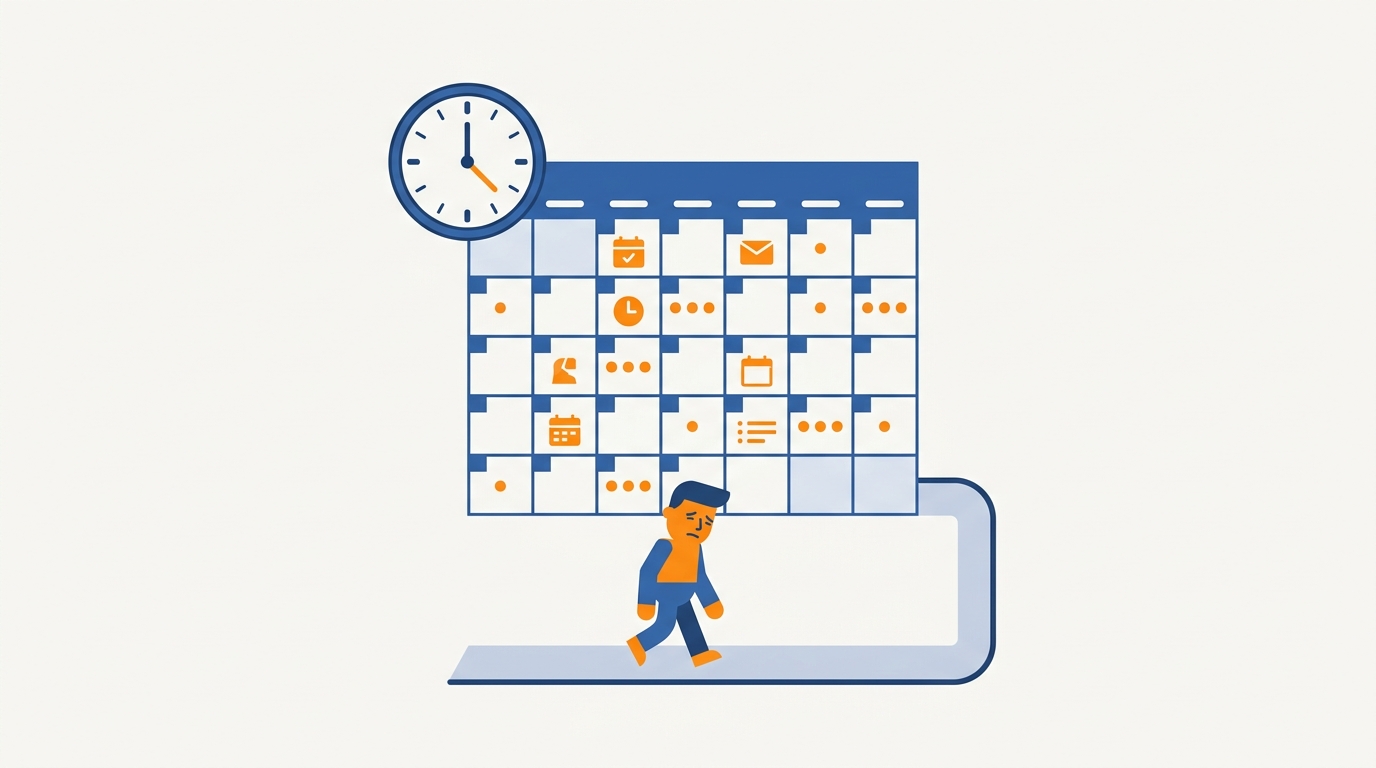
Four places vitality actually leaks
“I feel tired” does not tell you what to change. Energy drains usually fall into four categories.
Physical drains
Poor sleep. Sitting all day. Your body is already leaking, and then you sit down and ask it for a deep work block anyway.
Mental drains
Nonstop context switching. You bounce from one half-finished thing to the next and never give your brain a clean runway.
Emotional drains
A difficult project. A hard relationship. The work that stays on your chest even after you close the laptop.
Environmental drains
Clutter. A noisy workspace. A room that keeps pulling your attention sideways while you are trying to think.
When you feel depleted, start here. Name the drain. Physical, mental, emotional, environmental. More discipline is usually the wrong first move. Find the leak that makes good work harder than it needs to be.
Are you blaming a discipline problem for an energy leak?
Run a 24-hour Energy Audit
This is a low-friction experiment. One day. You are looking for where vitality leaks, not overhauling your life.
For the next 24 hours, every two hours, rate your energy from 1 to 10. Write down what you were doing, who you were with, and what environment you were in.
That’s the whole log.
At the end of the day, look for patterns. What pushed you toward a 10? What dropped you toward a 1? The same drain usually repeats. A person. A room. A type of meeting. A long stretch of sitting. A stretch of switching.
Then choose one drain to remove or one recovery ritual to add. One. That’s the assignment.
If you already know when you are sharpest, protect that window for your most important work. If mid-morning is your peak, reserve it for deep work. Push admin, batching, and lighter tasks into lower-energy periods. Open tomorrow’s calendar and move one low-value meeting or commitment out of that peak window.
Have you treated every hour tomorrow as if it had the same fuel?
Recover for real between focus blocks
After a focus block, use Clear to Neutral.
Close your tabs. Reset your desk. Step away from the screen. Hydrate. Move. Or simply look out a window.
Create real recovery. If you leave a focus block and go straight into social media, you just swapped work information for more information. Your attention stays fragmented. You feel like you took a break. The tank never filled.
Use Clear to Neutral between deep work sessions this week. Small habit. Real reset.
Do this today
Find one recurring drain. Seasonal or social. The same crash that shows up after the same kind of week. Put a boundary on it, and put a recovery plan next to it, before it happens again.
Then start the 24-hour audit. Every two hours, score yourself from 1 to 10. Write down the work, the people, and the room. Tonight, pick one drain to remove or one recovery ritual to add.
Start there.
Recommended for you
Want the full system? 25X is the flagship productivity system we teach.
Explore 25X →