I used to look at an open spot on my calendar and think, Great. I can fit something else in there.
Maybe you do this too. A meeting ends 10 minutes early, so you answer a few emails. You finish a project and immediately start the next one. Lunch becomes a browser tab, a protein bar, and Slack.
Then, around 3:30 p.m., you are technically still working but nothing is really moving.
The problem usually is not that you need a better color-coded calendar. It is that you planned your week as if your energy has no limits.
Work has a rhythm
A guest on our podcast described work less like an ultra-marathon and more like a set of focused sprints followed by intentional recovery. That framing stuck with me because it is obvious once you notice it.
You can have a strong 60- or 90-minute stretch. You can write, solve a messy problem, prepare for a difficult conversation, or get through a pile of decisions. But eventually your attention starts slipping. You reread the same sentence. You open an app without remembering why. The work takes longer and gets a little worse.
That is not a character flaw. It is a signal.
A calendar can tell you where your time went. It cannot guarantee you will have the energy for the work you put inside those blocks.
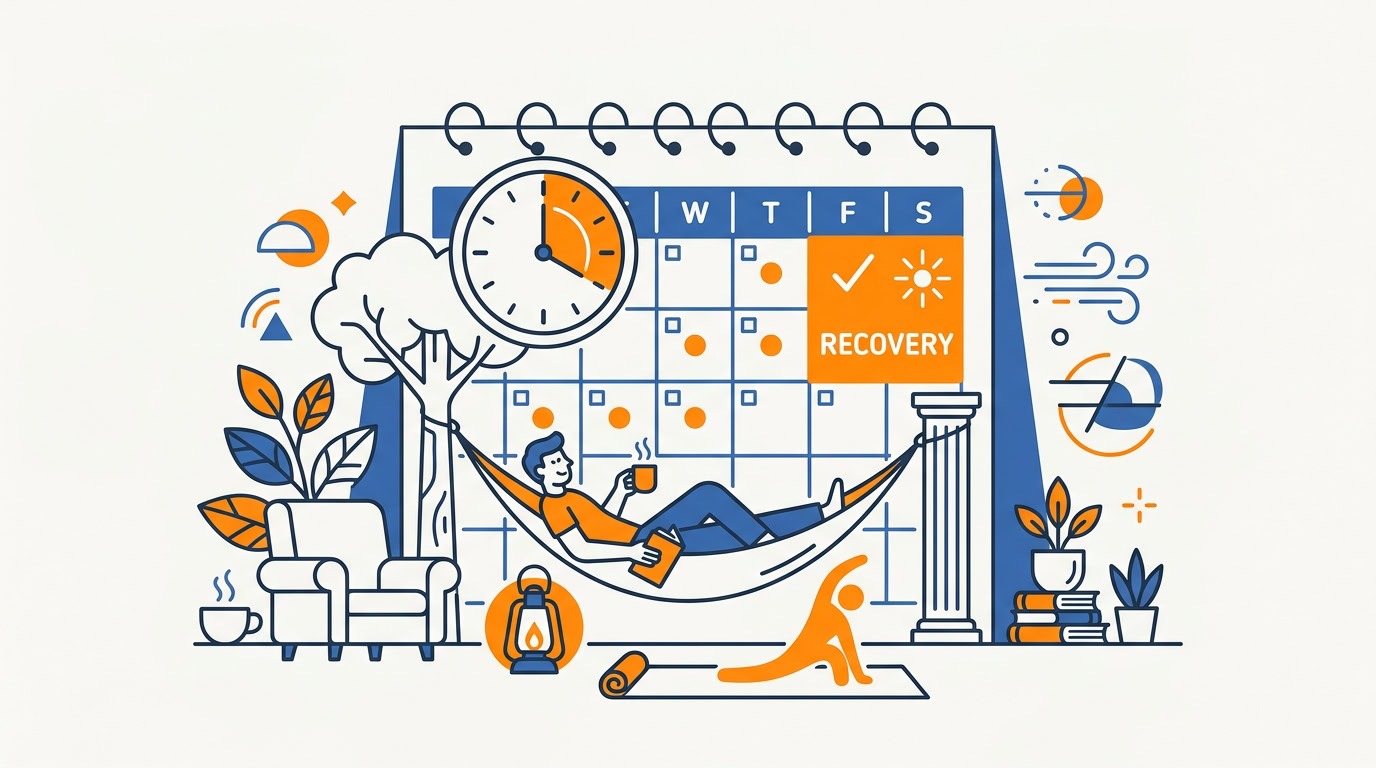
Recovery is part of the work
Most of us treat recovery as something that happens after a productive day. Finish everything, then rest. The issue is that “everything” keeps moving.
There is always another email. Another meeting. Another thing that feels too small to schedule but somehow eats 25 minutes.
So try flipping the order. Put recovery inside the workday before you need it.
This does not need to mean a two-hour spa appointment between calls. A useful recovery block can be very ordinary:
- A 15-minute walk without a podcast.
- Ten minutes to make tea, stretch, and look away from a screen.
- A real lunch away from your desk.
- A buffer after a demanding meeting before you reply to messages.
The point is to give your brain a chance to come down before asking it to perform again.
The empty space is doing something
White space can feel suspicious when your task list is full. You may worry that a blank block means you are falling behind.
But a blank block often prevents the kind of day where you are busy from 8 a.m. to 6 p.m. and still carry five loose ends into dinner.
It gives you room to process what happened in the last meeting. To write down the decision before it disappears. To notice that the task you planned for this afternoon actually needs an hour tomorrow morning.
That little bit of room also makes your system more honest. If every minute is booked, the first surprise of the day breaks the plan. And there is always a surprise. A coworker needs help. A client changes direction. Your kid gets sick. A file will not open. Normal life shows up.
Space is where normal life goes.
Try a sprint-and-recovery week
You do not need to rebuild your whole calendar. Start with one part of your week that regularly leaves you wiped out.
Maybe it is the morning full of calls. Maybe it is the afternoon you reserve for deep work, then ruin by checking email every 12 minutes.
For the next five workdays, try this:
- Choose one focused sprint. Protect 60 to 90 minutes for work that needs your full attention.
- Decide what “done enough” looks like before you begin. A rough first draft, a reviewed proposal, a plan for the next step. Keep it concrete.
- Schedule 15 to 20 minutes after it. No inbox. No catch-up task. Just step away.
- At the end of the week, notice when your best work happened and what happened right before your energy dropped.
You are not trying to create the perfect rhythm. You are collecting a little evidence from your own week.
Purpose changes the feel of hard work
One story from the episode has stayed with me. At a team meeting, someone shared how the group’s work had mattered far beyond the office. They thanked the people who made it possible.
Afterwards, people said they had been reminded why they were doing the work.
That does not mean purpose removes fatigue. It does not make a hard project easy. But knowing what the work is for can change what deserves your best hours.
When you plan next week, do not only ask, “Where can I fit this?” Ask, “What needs me at my best?”
Then leave enough room to actually show up that way.
Recommended for you
Want the full system? 25X is the flagship productivity system we teach.
Explore 25X →