How many decisions did you make before lunch?
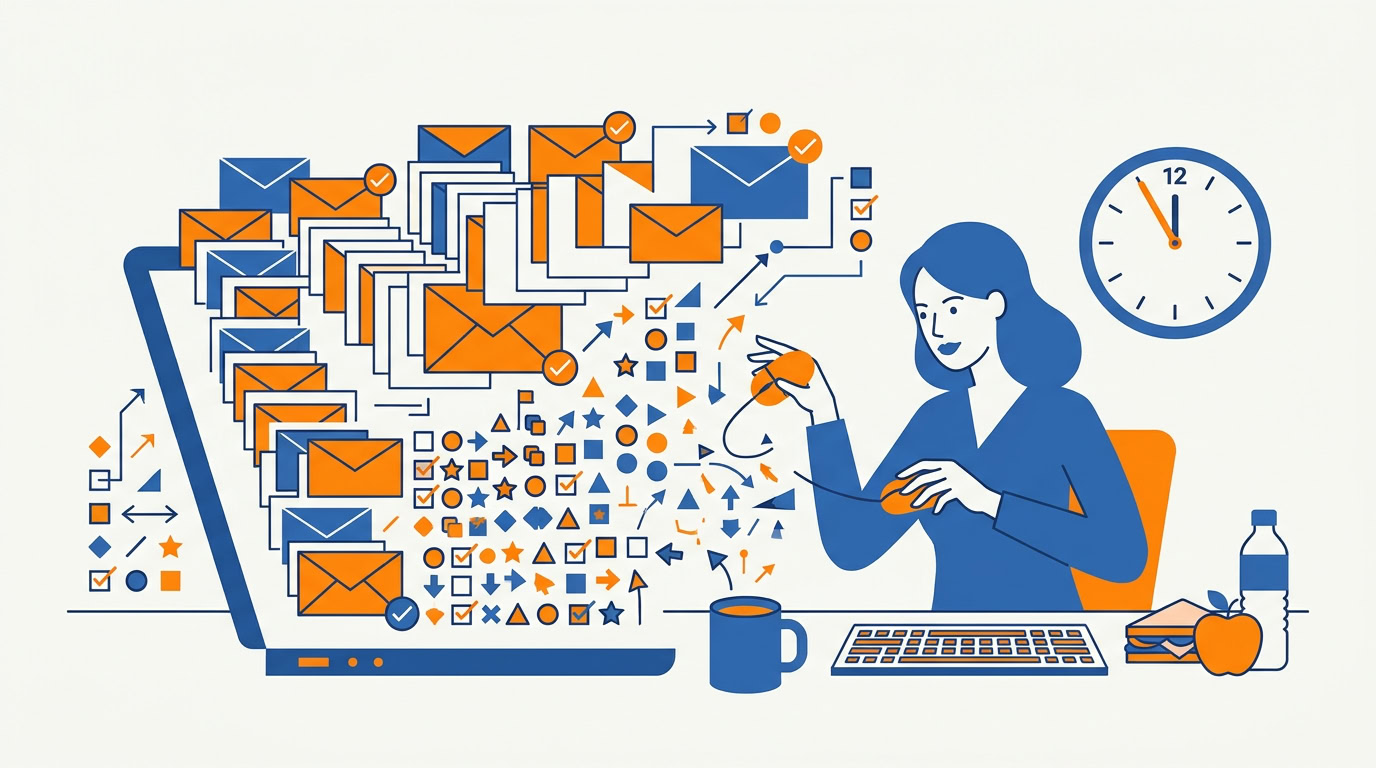
Start with the inbox. Processing a single email takes four micro-decisions: reply, flag, archive, or defer. Across 50 emails, that creates over 200 tiny choices before lunch. The work you sat down to do is still sitting there.
Call the total your decision debt. Count the messages you touched and multiply by four. The number rarely makes the task list. It still gets paid out of the attention you wanted for real work.
If follow-through feels shaky, check that number first. Drowning in micro-decisions will make a capable person look inconsistent. A serious productivity practice aims at fewer choices, made on purpose. If a team around you is struggling with execution, share that reframe. Ask where the extra decisions are hiding inside work they already know how to do.
Where the quality goes
Decision fatigue, in practice, is a subtle quality decay.
Micro-decisions accumulate. The brain defaults to the path of least resistance. Procrastination shows up. Overcomplication shows up beside it. A task with one concrete next move turns into a debate about the perfect approach. Treat the pattern as a system design issue. The volume of invisible choices is what bends the day.
Have you watched a simple task grow a planning phase it didn’t need?
Those are invisible decision points. Answer now, or later. Start the draft, or clarify the plan again. Stay with the task, or switch because the other one looks easier from a distance. They feel like logistics. They spend the same attention as a decision you would write down.
Research in healthcare and clinical decision-making describes what the room does to those calls. Repeated decisions in high-interruption environments correlate directly with shortcut-based choices. Environmental noise compounds cognitive load and degrades judgment quality.
Identify your highest-interruption zones. Name the hours when people, notifications, and half-finished threads arrive together. Use those hours to carry out decisions already made. Keep new decisions in a quieter block, while judgment is still intact.
Decide once
Which choice are you still paying for every morning?
Some decisions are stable, and you remake them anyway. Where a certain kind of email goes. What you do when someone asks for time. Which structure a repeated update should follow. Yesterday’s answer has nowhere to live, so you build a fresh one.
Decide once. Store the answer in a routine, a default, or a template. Recurring work gets a standard operating procedure. Work a machine can repeat is a candidate for automation. You pay the mental cost a single time. The daily re-evaluation stops.
Pick one recurring decision and systemize it this week. Write a sentence you can follow on a tired morning. Newsletters get archived. A vague request gets one template that asks for the actual ask. A repeated report starts from the same document. Boring is the point. That item is settled.
Decide earlier
When did you last make an important choice while the day was already interrupting you?
A chaotic, interruption-heavy workday is a rough place to decide anything that matters. A notification lands, a person needs a minute, a thread pulls you sideways, and in that stack you try to set a real priority. Repeated choices inside that noise slide toward shortcuts.
Decide earlier. Make important choices in a calm, clear state. Sunday planning is one window. The night before is another. Handle it the way weekly planning works, and the way you would pick your frog. The hard selection happens before the interruptions begin.
Schedule a 15-minute pre-decision block for tomorrow. Name the outcome that counts, the first action under it, and the interruptions that will try to reopen the choice. You arrive already decided. The noisy middle of the day only has to execute.
Decide smaller
What is the next visible action on the project you keep circling?
Large, abstract decisions create paralysis. The scope is too wide, so the brain stalls and task initiation sits there undone. “Fix the quarter.” “Clear the backlog.” “Get strategic about the offer.” Ambiguity keeps the stall in place. You can turn a sentence like that over for a long time and never touch the work.
Decide smaller. Shrink the scope until the next action is concrete and visible. Send one specific question. Write the first section only. Open the file and finish one defined piece. The rest of the project waits outside this decision.
Break your biggest current project into a single next step. Write that step where tomorrow morning can’t miss it. Complete the step before you reopen the wider plan.
Run this on your next inbox session
Email is where the three rules become one sitting you can run today.
Decide once by creating a processing system. Defaults for the message types you see constantly. A template for the reply you keep drafting from scratch. An archive rule for the mail you already know how to handle. The session executes a decision you already made.
Decide earlier by setting a fixed processing time. Pick the window while you are calm, inside the 15-minute block or during Sunday planning. “When do you process?” gets answered before a notification answers it for you.
Decide smaller by committing to one action per email. Reply, flag, archive, or defer. One, then the next message. One action closes the pause where all four options stay open.
Before the session, calculate the decision debt. Count the emails. Multiply by four. About 50 messages means over 200 tiny choices if each one stays fully open. Run the one-action rule from the first email to the last.
Retire one decision this week
Audit today for the invisible decision points. Mark the ones that repeat.
Pick one recurring decision from that list and systemize it before the week ends. One sentence. One default. Follow it the next time the choice shows up.
Recommended for you
Want the full system? 25X is the flagship productivity system we teach.
Explore 25X →