
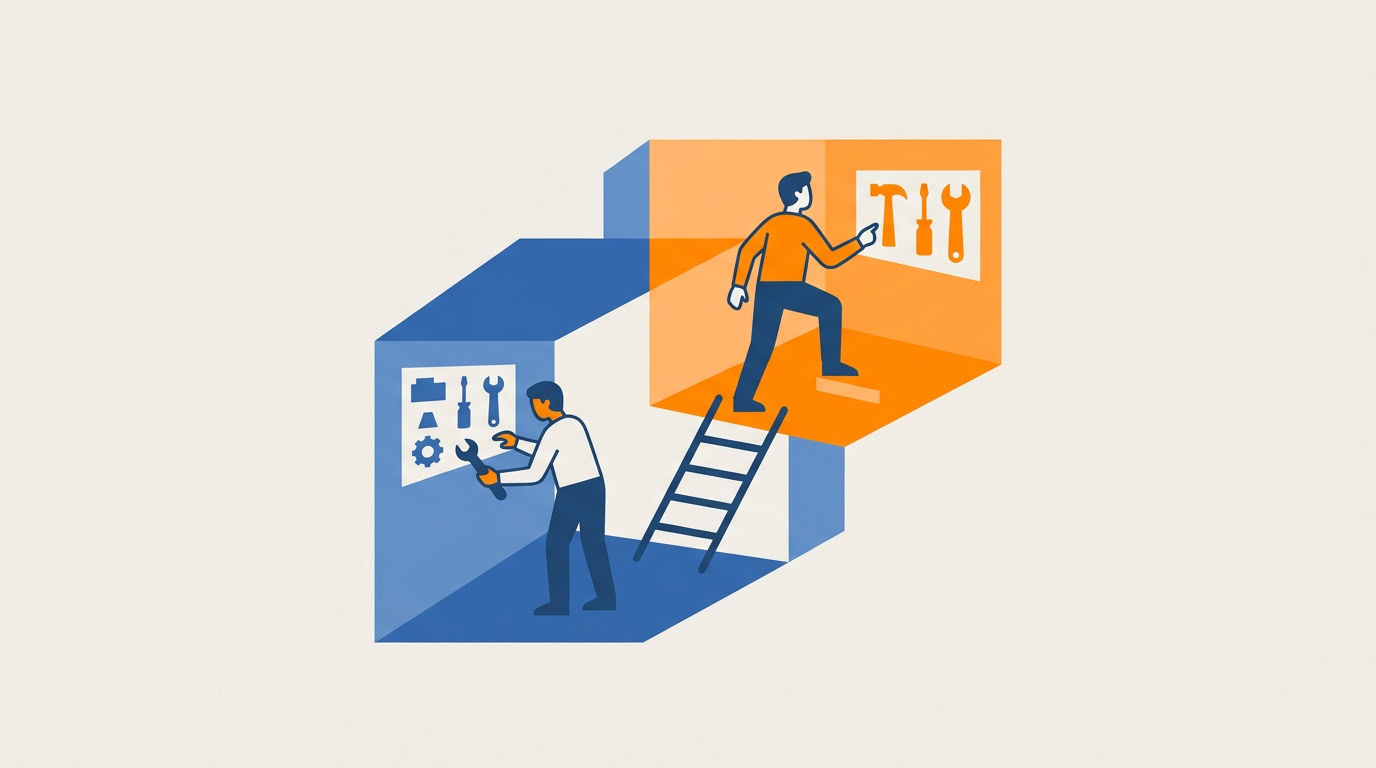
Switching productivity tools for a tiny improvement is like moving one floor up in a high-rise for a slightly better view.
You still have to pack. You still have to hire movers. You still have to reset your environment and absorb the hassle. You did the whole move, and the city looks almost the same.
Going from the bottom floor to the penthouse is different. The improvement is obvious and durable. That kind of jump can be worth the boxes.
Most tool switches are the one-floor kind. A new task manager. A new AI model. A tiny upgrade in an app you already have. You get curious, you start packing, and you spend your energy recreating the same system somewhere else. The view barely changed.
Brooks has a distinction I like. Self-improvement is not the same as fiddling. A mature productivity system helps you stop obsessing over the system itself so you can improve the parts of life that actually matter: skills, health, work quality, relationships, and follow-through.
Upgrading your to-do app is rarely the real bottleneck.
Does this sound familiar? The system becomes the project. You tinker. Meanwhile the skill you wanted to build, the health habit, the relationship you need to show up for, and the follow-through on actual work all sit and wait.
Clients often expect a complex system. My simplest productivity prescription is this: write down the three things you actually want to finish today, then show up consistently. The biggest gains usually come from basics like choosing a few critical priorities, going to bed earlier, or doing a short review. Not from a new app.
It sounds too simple. Do it anyway.
Switch on friction, not curiosity
Brooks’s practical test for upgrading: switch when you have a real friction point, not just curiosity.
He moved from one task manager to another because his old setup did not support the productivity methodology he was implementing. The tool was in the way of the method. That’s a real reason to pack.
He moved from a trackpad to a programmable mouse when video work made the speed gain obvious. The work made the speed difference hard to ignore.
Same rule in both cases. Friction first.
Before you migrate, run a friction audit. What is slowing you down repeatedly enough to justify a switch? Write it in one sentence.
If you can name a repeated constraint, you might be looking at a penthouse move. If the honest sentence is “I got curious,” stay on your floor.
Master one AI tool
The one-floor move is especially tempting with AI.
ChatGPT, Claude, Gemini, Grok, and other LLMs may each be better at certain tasks. That’s fine. Constantly switching tools still creates overhead. You pay a distraction tax every time you jump, and you never get excellent at any of them.
My guideline: master one core AI tool before jumping between every new model. Getting excellent with one AI assistant can deliver most of the value without that tax.
Are you switching because a task actually needs a different model, or because a new launch made you feel behind?
I have a second rule, and I want to be honest about it. This is an emerging personal guideline, not something I’m handing down as universal.
The next generation of productivity tools may be worth switching to when they are built around AI from the ground up, not when legacy apps simply bolt AI features on top.
I moved a personal CRM workflow into an AI-first CRM after using AI to help export and migrate the data. For me, that was the penthouse version. The destination was built around AI, so the hassle of exporting and migrating had a real payoff.
If the AI is bolted on, treat it like one extra floor of view. If the workflow is AI-first, then the moving cost is at least in the conversation.
Put the energy into the work
If you’re going to upgrade something this week, upgrade the basics.
Three finish lines
Write down the three things you actually want to finish today. Then show up and finish them. Tomorrow, pick three again. Clients want the complex version. This is the version that moves work.
A weekly review with two questions
Brooks’s rule: a weekly review does not need to be a 25-step ritual. At its core, it just needs to answer two questions. Is everything up to date? Do I know what I’m doing next?
A quick Sunday scan is dramatically better than skipping the review because the perfect version feels too heavy. Have you been avoiding it because it turned into homework? Ask the two questions. That’s the review.
Thirty minutes on work that can wait
Brooks presents the 30/30 Method as a simple way to act on the important-but-not-urgent quadrant without a complicated Eisenhower Matrix workflow. Spend at least 30 minutes each day on something that is not due for at least 30 days.
That’s how skills, health, work quality, and the follow-through that never feels urgent actually get time. The deadline is far enough away that today will always try to steal the slot. Take the 30 minutes anyway.
Right now, write down the three things you want to finish today. Then go do the first one.
Recommended for you
Want the full system? 25X is the flagship productivity system we teach.
Explore 25X →