
A college student I coached showed me a task list with nearly 20 completed items. It looked great at first glance. Lots of boxes checked. Lots of AI-assisted output.
Then I asked him which items supported his organization’s goal for the quarter.
One did.
The other tasks were not bad tasks. Some were useful. A few were personal priorities. Yet the list had given him a false sense of progress. He had been busy. The outcome that mattered had barely moved.
AI makes this easier to do at a much larger scale. You can draft reports, summarize calls, sort research, write follow-ups, build spreadsheets, and create ten versions of something before lunch. That is useful. It also means you need to decide what deserves that speed.
I use a simple model for this: 80-10-10.
The first 10% is deciding what good looks like
Before you open ChatGPT, Claude, or any other tool, pause for a minute.
What are you trying to get done? Who is this for? What will tell you the work is finished?
That is the first 10%. It is often the part people skip because it feels slower than typing a prompt. Then the AI gives them something polished that answers a slightly different question.
Say you need to prepare for a client meeting. “Make me a meeting brief” is a start. It leaves a lot of room for guessing.
A clearer version might be: “Create a one-page meeting brief for a client renewal conversation. Include the last two meeting commitments, open issues, current usage concerns, and five questions I should ask. Flag anything that needs my judgment before the call.”
The AI now has a job. More importantly, you do too. You have defined what you are looking for.
If you are unsure what details to provide, flip the script. Ask the AI to interview you first: “What do you need to know from me before you create this?”
That one sentence changes the interaction. You are no longer trying to guess the perfect prompt from a blank page. You are giving the tool a way to collect the context it needs.
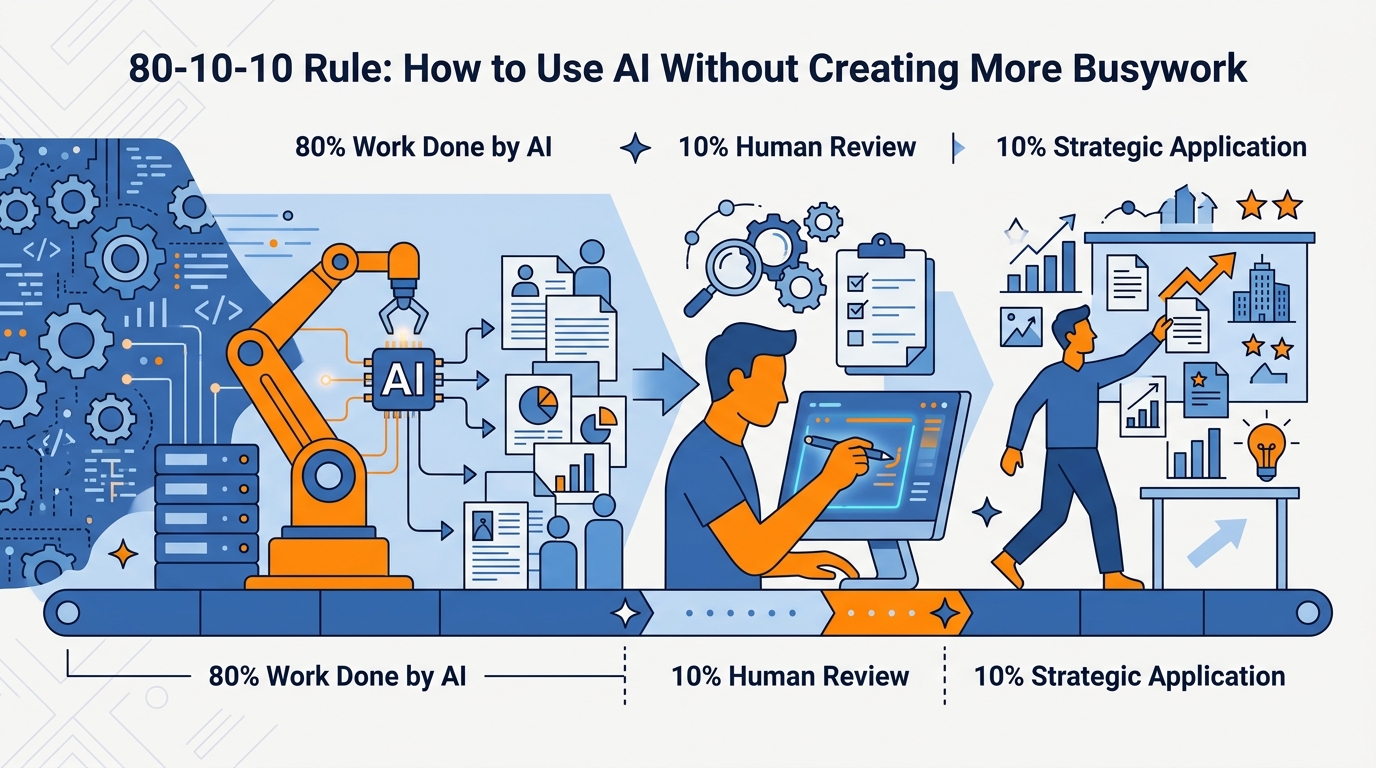
The middle 80% is where AI can do the heavy lifting
Once the outcome is clear, hand over the work that is repetitive, time-consuming, or easy to review.
This could include:
- Turning rough meeting notes into a first draft of follow-up tasks
- Comparing a pile of customer comments for recurring themes
- Creating a first pass at an agenda from a project update
- Organizing a research document into sections you can verify
Notice what these have in common. The work has a shape. You can explain what a finished version should contain. You can check it without starting from scratch.
That is a good fit for AI.
Some work still belongs with you from start to finish. Booking the familiar flight route you take every few months may be faster manually. Choosing groceries can depend on what sounds good that day, what is already in the fridge, or who is coming over. A personal message may need your actual words instead of a clean draft that sounds like no one in particular.
You do not need to force every task through AI. The point is to use it where it removes effort without creating a new review project.
The final 10% protects your standards
The last 10% is where you read the output like the person whose name will be attached to it.
Is it true? Does it sound like you? Did it miss context only you would know? Is the recommendation actually useful, or is it simply well formatted?
This final pass matters more now because generic AI work creates a credibility tax. A report can be accurate and still feel off. An email can be grammatically perfect and still sound unlike the sender. People may not say why they trust it less. They just do.
You do not need to rewrite every sentence. You need to add the human part: judgment, specificity, voice, and the details that tell the reader a real person paid attention.
That is why the student’s task list mattered. He did not need more completed tasks. He needed a clearer result to aim at, then a way to tell whether the work was helping.
Try this with one recurring task
Pick one task you do every week. Maybe it is preparing for a meeting, writing a project update, reviewing customer feedback, or building a plan for the week.
- Write one sentence describing the outcome.
- Add a definition of done. Be specific about what the finished work needs to include.
- Give AI the middle portion of the task.
- Review the output before it goes anywhere.
Keep the first attempt small. You are not rebuilding your workday. You are testing whether one task becomes easier to finish without losing the part that needs you.
At the end of the week, look at the result rather than the number of prompts you used. Did the task move something forward? Did you trust the final output enough to send it? That is the score worth keeping.
Recommended for you
Want the full system? 25X is the flagship productivity system we teach.
Explore 25X →