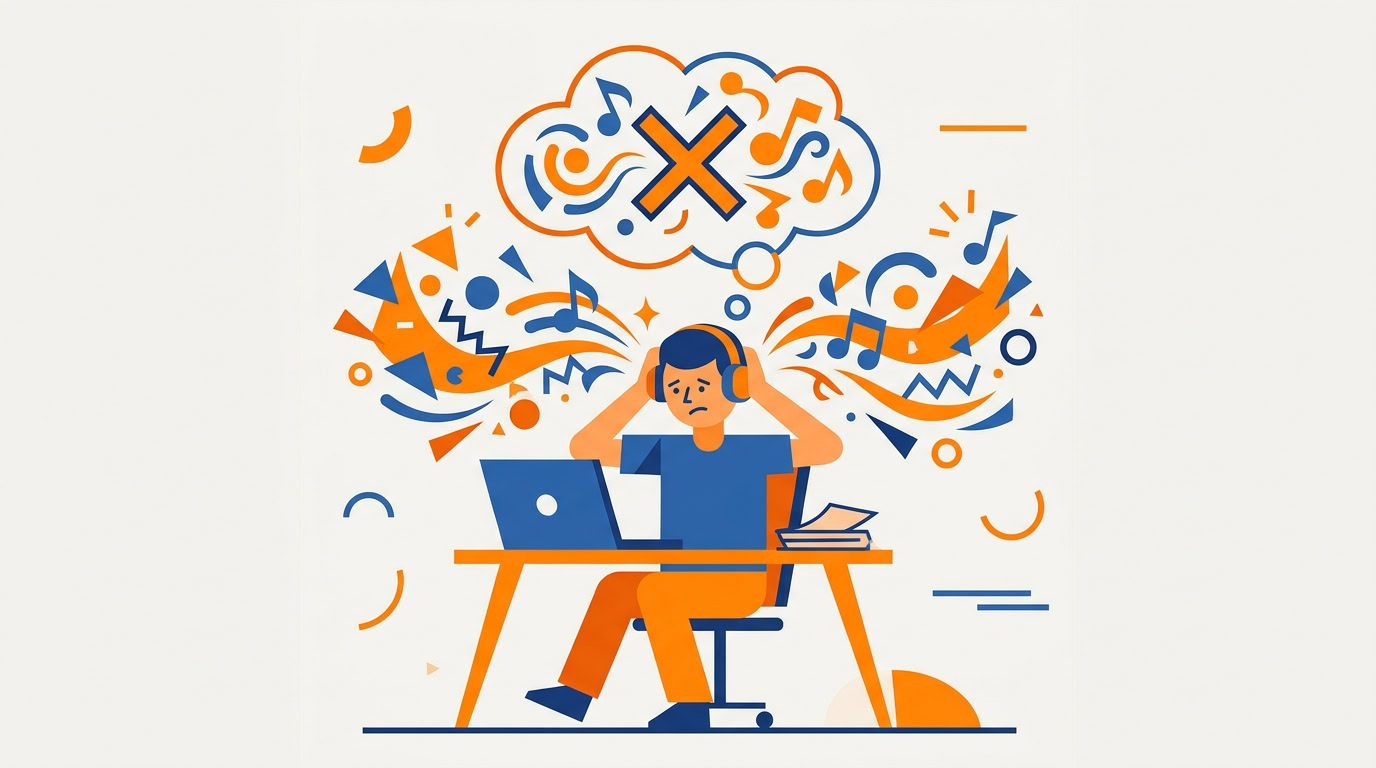
I like music I can’t work to. Lyrics draw my attention toward the words and their meaning. Instrumental soundtracks help me settle into the work. Sudden, attention-grabbing changes in the sound can interrupt concentration too. The track has to stay in the background. Liking it is a weak test. What would you measure instead?
Skepticism of focus music is common at first. The benefit shows up afterward, looking at what got finished and how focused the session felt. The test is straightforward. Put real work in front of you. Choose a track you like. Let it fade into the background. When you stop, ask what you finished and how focused you felt. Checking the music during the session pulls attention off the task.
I’m no neuroscientist. This is what lyrics do to my attention, and what can show up when the music is tried on real work. Run your own low-pressure version. Take two similar sessions. Give one a lyric-free soundtrack and the other your usual playlist. After each session, write down the work you completed and how distracted you felt. That log will tell you whether the soundtrack is useful for you.
When your state and the work don’t match
Sometimes you are in the wrong frame of mind for what is in front of you.
Watch for a mismatch between your state and the work. Then change your state, or change the task, depending on what you can control.
Build a short reset menu: take a walk, change rooms, use focus music, or switch to a task that fits your current capacity. Pick the one you can control and do that one next.
Does the work in front of you match the state you’re actually in?
Write three answers before you build the day
Separate morning planning into three questions. Write obligations, success criteria, and a structured brain dump before you organize the day.
What do I need to do today?
What would make today successful?
What else is occupying my mind?
Completing the required tasks and having a successful day are different things. The third question is where personal concerns go. Write a few thoughts about them.
Make a three-section template and fill it in tomorrow morning. Obligations in the first section. What would make the day successful in the second. In the third, the brain dump, including a few lines on the personal concerns, written out so they’re acknowledged. Then organize the day from those notes.
Have you had a day where the list got done and the day still felt off? Write that into the second section in plain language.
Price the work, then put it on a day
During roughly an hour of Sunday planning, look at the cost of the work. Difficulty. Emotional resistance. A task can fit your calendar and still be a poor fit for the energy you expect to have.
One pattern is harder work on Monday and Tuesday and easier work on Friday. Yours should follow your energy and your commitments. Where does your harder work actually belong? Before you assign next week’s tasks to days, tag each one for difficulty and emotional load.
The other side of the paper
Start a focus sprint with paper. Write the two or three things you will work on during a 60-minute block, put on headphones, and turn off notifications. If an unrelated thought or task appears, capture it on the other side of the paper, flip back, and continue. The paper gives the distraction somewhere to go, and the block stays with the list you wrote at the start.
Sixty minutes is one example. If you want the physical version, make a simple sheet with the task list on one side and a distraction-capture area on the other.
The entry can be the same every time. Choose the work. Silence notifications. Start the background music. That sequence is the way in, and you can start it before you feel ready.
Let a transcript do the remembering
An AI meeting assistant can turn a call into a searchable transcript, so you can find what was discussed without relying entirely on memory or on manual note-taking.
If you pilot one, keep it to one recurring meeting. Use an assistant that’s been approved for that use. Get consent from the participants. Afterward, check the important decisions and action items against the transcript.
Look at one workflow you repeat. Separate the human judgment, the expert constraints, and the machine-assisted execution. Keep the judgment with a person.
Zoom out until the week makes sense
After several unproductive days, zoom out like a map. Street level is today’s tasks. Above that sit goals, then broader objectives, then core values. Move upward until you can see what is out of alignment, then work back down to a clearer next action.
Add the check to your weekly review. Which goal does this task serve, which objective does that goal serve, and which value does that objective support?
Tomorrow morning, before you touch the calendar, write the three questions on a page and answer them. What you need to do. What would make the day successful. What else is occupying your mind, with a few thoughts written down about the personal concerns. Start there.
Recommended for you
Want the full system? 25X is the flagship productivity system we teach.
Explore 25X →